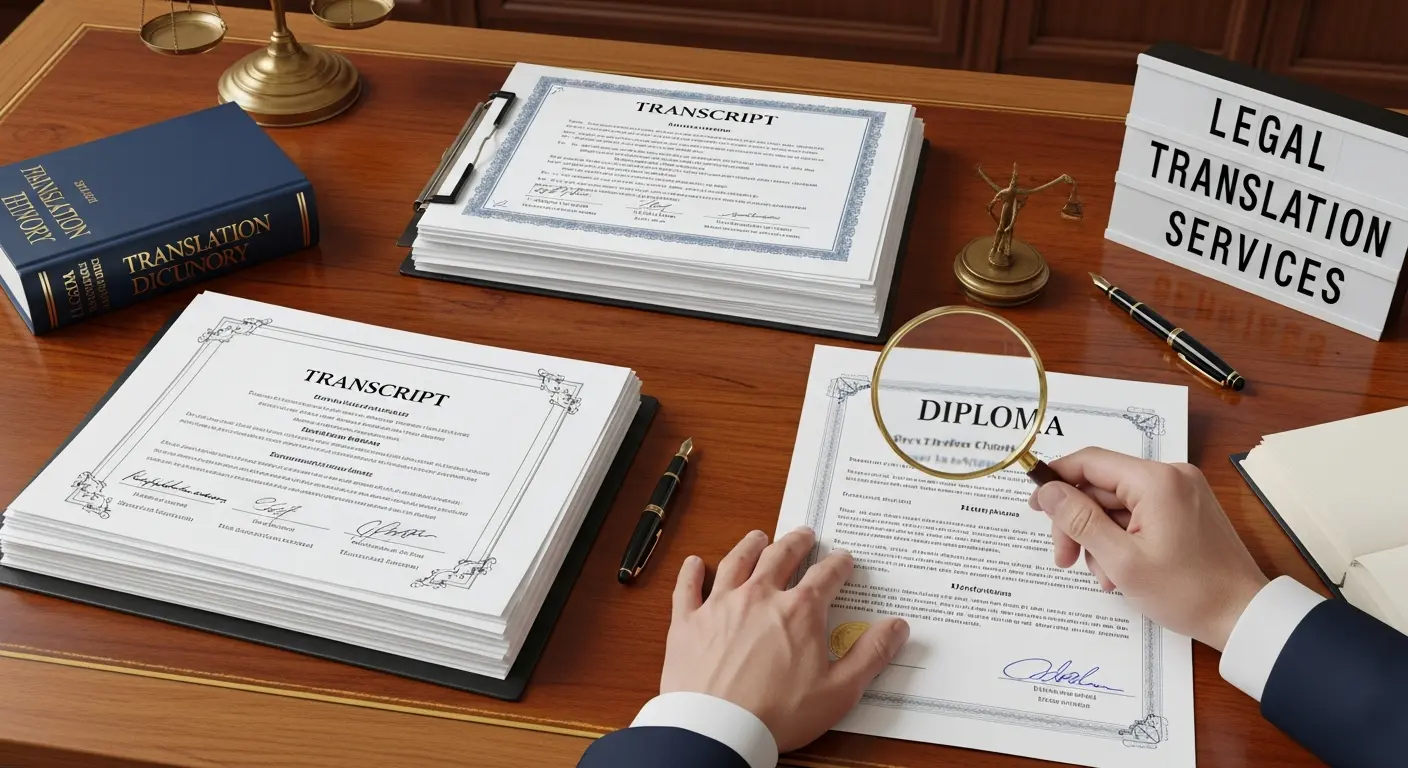
Whether you are applying to a university, seeking professional licensing, or submitting an equivalency request in the UAE, the accuracy and acceptance of your academic documents depend on one critical step: legal translation. In the education sector legal translation, institutions and authorities often require translations that meet strict regulatory standards, preserve every detail of your records, and include the correct certifications.
This guide explains how to handle transcripts, diplomas, certificates, and other academic records so they are recognized by schools, ministries, and embassies across the UAE and abroad. See the pillar resource for a more comprehensive understanding of terminology, processes, and provider selection. Complete overview: “Legal Translation Services: The Complete Guide“.
What Counts as Academic Records, and When Are Translations Required?
Academic records encompass more than a single diploma. Education sector legal translation providers, government bodies, and scholarship committees typically expect comprehensive documentation. Understanding what you may need to translate helps you prepare once and avoid costly delays.
Common Education Documents that Often Require Legal Translation
- School and College Records: transcripts, mark sheets, report cards, diplomas, graduation certificates, thesis abstracts, letters of recommendation, course descriptions/syllabi
- Administrative and Identity-Linked Education Documents: enrollment letters, attendance records, student ID letters, name-change or marriage certificates linked to identity on records
- Postgraduate and Professional Documents: degree certificates, postgraduate diplomas, professional training certificates, internship records, licensing exam results
- Institutional Materials: accreditation letters, official policies, MoUs between institutions, and selection criteria for exchange programs
In the UAE, legal translation is commonly required when you:
- Apply for university or school admission where the language of instruction or administration differs from your document language
- Submit documents to the UAE Ministry of Education for academic equivalency
- Pursue professional licensing (e.g., healthcare regulators like DHA/DOH or other sector regulators) that require verified education credentials
- Process visas that involve education verification (e.g., family sponsorship, skilled worker permits)
- Undertake embassy authentication or MOFAIC attestation of foreign-issued records
Why Education Sector Legal Translation Matters in the UAE Landscape

Legal translation is not just a word-for-word conversion. It is an official education sector legal translation that meets the acceptance standards of ministries, courts, and public authorities. In the education sector, this standard ensures that your records hold the same evidentiary value as the original documents when reviewed by admissions offices, ministries, or professional bodies.
- Compliance: Many authorities and institutions in the UAE specifically request legal translations that are produced by translators licensed by the Ministry of Justice.
- Clarity: Academic documents include technical details (course codes, credit hours, and grade scales) that must be preserved precisely.
- Continuity: Transliteration of names, consistent date formats, and replicating stamps and seals prevent discrepancies across multiple submissions.
- Recognition: Proper translations facilitate equivalency decisions, licensing approvals, and successful visa processing.
Sim-trans Legal Translation & Interpretation Services, located in Dubai and Abu Dhabi and serving the entire UAE, specializes in translating legal documents for the education sector, ensuring they meet the expected formats, terminology, and certifications.
The UAE Regulatory Landscape and Acceptance Criteria
The acceptance of translations in the UAE depends on authority and purpose. Universities and schools may accept certified translations for admission reviews, whereas ministries or attestation chains typically require legal translations from licensed translators, which are then followed by attestation steps.
1. When is a legal translation from the Ministry of Justice typically required?
- Submitting foreign-issued diplomas and transcripts for UAE equivalency or government review
- Using translated records in official processes (e.g., licensing, notarization, court-related matters)
- Completing embassy or MOFAIC attestation steps where official translation is specified
2. High-level Attestation Pathway for Education Documents
Note that exact sequences and requirements vary by country of origin and destination, as well as document type. Always verify the latest guidance.
- For Foreign-Issued Academic Records Used in the UAE: Typically legalized in the country of origin (e.g., Ministry of Education, Ministry of Foreign Affairs, UAE Embassy), then attested by the UAE Ministry of Foreign Affairs and International Cooperation (MOFAIC). A legal translation into Arabic or English may be required for UAE authorities.
- For UAE-issued records used abroad: local authority verification (e.g., KHDA in Dubai or ADEK in Abu Dhabi, if applicable), MOFAIC attestation in the UAE, then legalization by the destination country’s embassy. A legal translation into the destination language is often required.
Sources:
[1] Federal decree by law regulating the translation profession. (2022, September 26). UAE Ministry of Justice. Retrieved December 1, 2025, from https://uaelegislation.gov.ae/en/legislations/1568
[2] KHDA Services. (n.d.). Knowledge and Human Development Authority (KHDA). Retrieved December 1, 2025, from https://web.khda.gov.ae/en/services
[3] MOFAIC services. (n.d.). UAE Ministry of Justice. Retrieved December 1, 2025, from https://www.mofa.gov.ae/Services
[4] ADEK services. (n.d.). Abu Dhabi Department of Education and Knowledge (ADEK). Retrieved December 1, 2025, from https://www.adek.gov.ae/
Certified vs Notarized vs Legalized Translations: What Institutions Mean
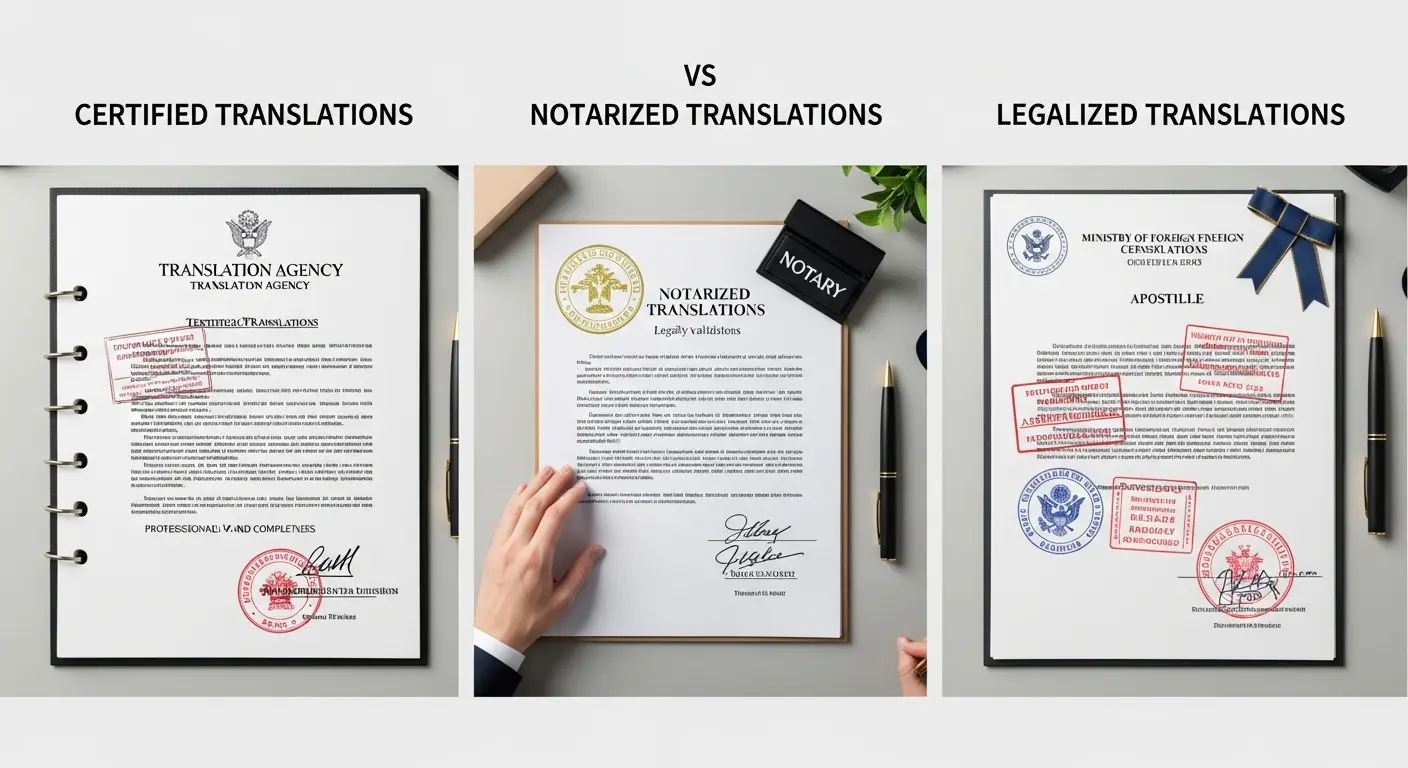
Terms differ by region, which can cause confusion. Here is a quick comparison to help you request exactly what your institution requires.
| Term | What it means | Typical use in the UAE education context | Who issues it |
|---|---|---|---|
| Legal translation | Official translation by a Ministry of Justice-licensed translator, bearing required seals and formats | Frequently required for ministries, government submissions, and some university processes | MOJ-licensed legal translator (e.g., via providers like Sim-trans) |
| Certified translation | The translator/company attests the translation’s accuracy with a signed statement | Sometimes accepted by universities for admissions review; may not suffice for government | Professional translation provider |
| Notarized translation | Translation or translator’s statement notarized by a notary public | Required by specific foreign institutions or immigration bodies | Notary public plus translator |
| Legalized/authenticated document | Document and/or translation legalized through MOFAIC and relevant embassies | Often needed for cross-border recognition and equivalency | MOFAIC, embassies, competent authorities |
When in doubt, it’s best to ask the receiving institution to provide the exact requirement in writing. Sim-trans can then produce the correct legal translation or coordinate the appropriate certification route.
The End-to-End Process With Sim-trans for Academic Records
Sim-trans Legal Translation & Interpretation Services provides a streamlined process tailored to the education sector for legal translation, ensuring your transcripts and diplomas meet acceptance standards in the UAE and internationally.
- Document Assessment and Scope Confirmation: Share clear scans or photos of all pages (front and back) of your transcripts, diplomas, and any attached annexes or grade scales. Sim-trans will confirm if legal translation is required and note any attestation dependencies.
- Quote and Turnaround: You receive a transparent quote and timeline. The standard turnaround time varies based on the volume and complexity of the documents, and express options are available for urgent admissions or visa deadlines.
- Terminology and Transliteration Alignment: To ensure consistency across all legal translation outputs, please provide your passport name spelling along with any previously accepted spellings (e.g., from past visas or certificates).
- Translation Production: Sim-trans reproduces layout elements, including tables, stamps, signatures, QR codes, and watermark notations, to preserve their evidentiary value.
- Quality Assurance: The multi-step review process includes checking for linguistic accuracy, ensuring formatting consistency, cross-checking date formats and grade scales, and verifying the use of consistent terminology.
- Certification and Delivery: Education sector legal translation is finalized with required stamps, signatures, and seals. You will receive secure e-copies for review and can arrange for physical copies to be picked up or delivered by courier across the UAE.
- Follow-on Support: If you need MOFAIC or embassy attestations, Sim-trans can guide you through the process or collaborate with your legalization service provider.
Language Pairs and Formatting Considerations for Education Documents
Academic records are data-heavy. Proper legal translation not only converts text between languages but also preserves the structure and context that admissions officers and ministry reviewers depend on.
1. Common language pairs handled in the UAE
- Arabic to English (most common for government and education submissions)
- French, German, Italian, Spanish to Arabic/English
- Russian and Ukrainian to Arabic/English
- Urdu, Hindi, Punjabi to Arabic/English
- Persian (Farsi), Turkish to Arabic/English
- Chinese (Simplified), Japanese, Korean to Arabic/English
2. Formatting and content fidelity
- Tables and Grids: Transcripts feature tables for courses, grades, and credits. These elements must be accurately mirrored in the legal translation.
- Stamps, Seals, and QR Notes: Visible seals or QR codes are referenced in the translation and, where appropriate, transcribed or annotated.
- Grade Scale Explanation: If the original document uses a 4.0 GPA, a 10-point scale, or a percentage system, the translation should maintain the original format and include a note when provided by the institution (avoid arbitrary conversions).
- Names and IDs: Match the spelling of your personal name to your passport and keep it consistent across all submissions.
- Dates and Calendars: Convert dates clearly and consistently, and indicate if Hijri dates are present in the original documents.
Tip: Share any official glossary or standard program names used by your institution to ensure the legal translation reflects recognized terminology.
Timelines, Pricing Factors, and How to Save Time
Legal translation timelines depend on document volume, language pair, complexity, and certification needs. In the UAE, scheduling around admission cycles and visa processing is time sensitive; therefore, it is important to plan early to avoid rush fees.
1) What Affects Turnaround and Cost?
- Volume and Complexity: Multi-page transcripts with dense tables take longer than single-page diplomas.
- Language Direction: Legal translations for less common languages may require senior specialists, which can affect timelines.
- Certification Pathway: The process of notarization or legalization, which goes beyond standard legal translation for the education sector, adds additional steps and costs.
- Formatting Needs: High-fidelity layout reproduction for detailed transcripts requires additional time and effort.
2) Time-saving strategies
- Submit all pages, annexes, and backside notes together to avoid additional work and rework.
- Confirm the Requirement: Obtain the receiving institution’s translation and attestation guidance in writing.
- Ensure Personal Data is Accurate: Provide the correct spelling of your name as it appears on your passport, along with any previously accepted variations, to prevent mismatches.
- Choose Express Options Judiciously: Sim-trans provides expedited legal translation services when your deadline is approaching.
Mistakes to Avoid When Translating Academic Records
Small discrepancies can derail an application. The correct process can prevent these issues.
- Name Inconsistencies: Variations in your name across passport, visa, and certificates lead to queries. Align spelling before legal translation begins.
- Unclear Scans: Low-resolution images hide stamps and signatures. Please provide high-quality scans or the original documents for accurate reproduction.
- Missing Backside Translations: Many certificates include text on the reverse side (notes, grade scales). Always include both sides.
- Format Confusion: Ambiguous date formats (e.g., 03/04/2022) should be standardized and clarified in the legal translation.
- Translated Annexes: Institutions often expect course descriptions or scale explanations; if these documents exist, they should be included in the scope of the translation.
Case Snapshots: How Sim-trans Supports Students and Institutions
1) Dubai Student Applying to a Canadian University
Challenge: translations of Arabic transcripts, a diploma, and a translator’s affidavit.
Solution: Sim-Trans prepared legal translations for the education sector specifically for use in the UAE and provided certified translations that were tailored to the university’s submission portal, ensuring that both the ministry and the university accepted the documents without delay.
2) Abu Dhabi Engineer Seeking UAE Equivalency and Professional Licensing
Challenge: Multiple documents, including the diploma, mark sheets, and internship record, needed to be aligned with the passport’s spelling and attested for equivalency.
Solution: Sim-trans delivered coordinated legal translation across all documents, maintained consistent transliteration, and guided the client on MOFAIC and embassy steps. The aligned package expedited the equivalency review process and the subsequent licensing.
3) K-12 School Onboarding International Students Across the UAE
Challenge: A school group in the UAE needed to verify student records from multiple countries each term.
Solution: Sim-trans created a repeatable workflow for legal translation, including checklists for parents, standardized naming rules, and fast-track options. ThThe result included smoother admissions, faster placements, and fewer delays related to documents.
A Practical Checklist You Can Use Today
- Identify the receiving body and ask for written requirements: legal translation, certified translation, notarization, or legalization
- Collect complete sets: every page of transcripts, backsides of certificates, annexes, and grade-scale sheets
- Provide identity details exactly as per passport to guide consistent transliteration
- Confirm language of translation (Arabic or English) for UAE authorities or the destination language if applying abroad
- Verify attestation needs in sequence (e.g., KHDA/ADEK, MOFAIC, embassy) before starting
- Share your deadlines and opt for express service if needed
- Review e-copies carefully before printing or submission
Frequently Asked Questions
Q: Do all universities require legal translation, or is certified translation enough?
Requirements vary. Many universities accept certified translations for admissions. However, for government processes (equivalency, licensing, or attestation), legal translation by an MOJ-licensed translator is often required. Always obtain the institution’s written policy.
Q: Will a color copy of my document be necessary?
High-quality color scans are recommended so seals, stamps, and security features are visible and correctly referenced in the legal translation. Some authorities may require that originals be viewed during the attestation process.
Q: Can I submit digital legal translations, or do I need physical copies?
Many institutions accept secure e-copies for initial review, but official submissions may require stamped tangible copies. Sim-trans provides both formats and can arrange courier delivery across the UAE.
Q: How long does legal translation take for transcripts and diplomas?
Turnaround depends on volume, language pairs, and formatting complexity. Simple diplomas can be done quickly; multi-page transcripts may take longer. Express options are available to share your deadlines when you request a quote.
Q: What if my grade scale is different from the UAE norm?
Education sector legal translation will faithfully reproduce the original scale and any institutional notes. Avoid converting scales unless the receiving body specifically instructs it. If needed, please include your institution’s official scale explanation with the translation package.
How Sim-trans Makes Education Sector Legal Translation Easier
Sim-trans Legal Translation & Interpretation Services is a UAE-based provider with offices in Dubai and Abu Dhabi, serving clients nationwide. Legal translation for the education sector that follows UAE rules and meets the needs of students, parents, schools, and universities is very important. Benefits include:
- MOJ-licensed legal translators for Arabic and major international language pairs
- High-fidelity formatting for transcripts and certificate layouts
- Consistency in names, dates, and document references across your entire file
- Clear timelines, express options, and secure delivery anywhere in the UAE
- Guidance on attestation pathways and coordination with legalization partners
Whether you are preparing an application for a Dubai or Abu Dhabi institution, seeking MOE equivalency, or sending UAE-issued documents abroad, Sim-trans helps you avoid common pitfalls and submit your documents with confidence.
Conclusion: Submit With Confidence Through Accurate Legal Translation
Education journeys hinge on the integrity of your records. Universities, ministries, and embassies in the UAE and around the world will accept your transcripts, diplomas, and academic documents only if they are accurate and compliant.
If education sector legal translations are working toward admissions, equivalency, or licensing, Sim-trans Legal Translation & Interpretation Services can manage your end-to-end translation package, align formatting, and prepare the certifications you need on time. To better understand the broader landscape of requirements and service options, visit the pillar resource: Complete overview: “Legal Translation Services: The Complete Guide“.