
Abu Dhabi is one of the region’s most important political, commercial, and cultural hubs, where multinational companies, diplomatic missions, and government entities meet every day. In this environment, interpretation services in Abu Dhabi are not simply a convenience; they are a legal and operational necessity. From courtrooms and notary offices to ministerial meetings and international conferences, the way you choose and manage interpreters in Abu Dhabi can directly impact legal outcomes, business deals, and government compliance.
This guide explores how interpretation works in Abu Dhabi’s government and semi government settings, what protocols you must follow, and how to select the best interpretation partner for your needs. It builds on the broader concepts covered in the main guide, “Interpretation Services: The Complete Guide to Choosing, Buying, and Succeeding.”
As a UAE-based language services provider with offices in Dubai and Abu Dhabi, Sim-trans Legal Translation & Interpretation Services helps individuals, businesses, and public-sector clients navigate these requirements while ensuring accurate and compliant multilingual communication across the Emirates.
1. Why Interpretation Services Matter So Much in Abu Dhabi
Abu Dhabi’s legal and administrative ecosystem operates primarily in Arabic, with English as the main business language. Yet, daily interactions involve speakers of Urdu, Hindi, Russian, French, Chinese, and many other languages. When legal rights, government approvals, or regulatory filings are at stake, miscommunication can create serious risk.
Key reasons interpretation services are critical in Abu Dhabi include:
- Legal compliance: In courts, prosecution offices, and notary departments, proceedings must be fully understood by all parties. Interpreters help ensure procedural fairness and adherence to UAE laws.
- Government approvals and licenses: Investor meetings, regulatory hearings, and licensing appointments often require clear interpretation to avoid delays or rejected applications.
- Diplomatic and protocol events: Abu Dhabi regularly hosts high-level delegations, summits, and state visits, where simultaneous interpretation is essential.
- Business expansion: International companies opening branches in Abu Dhabi rely on interpreters for negotiations, HR onboarding, compliance training, and partnership discussions.
- Personal matters: Residents and visitors need assistance for immigration procedures, marriage contracts, property transactions, and medical consultations.
Working with a reliable partner like Sim-trans Legal Translation & Interpretation Services helps you bridge language gaps while respecting the legal and cultural framework specific to Abu Dhabi and the wider UAE.
2. Overview of Government Related Interpretation Protocols in Abu Dhabi

Every government and semi government body in Abu Dhabi follows internal policies, but there are recurring patterns you should be aware of when planning interpretation for official purposes. Understanding these protocols early saves time, protects your case or application, and avoids last minute cancellations.
2.1 Common Government and Semi Government Settings
- Courts and prosecution offices
- Police stations and investigation units
- Notary public offices and judicial departments
- Ministries and federal authorities
- Free zone authorities and regulatory bodies
- Immigration and residency departments
- Hospitals and government health authorities
In these settings, interpretation is often required for:
- Hearings, trials, and witness statements
- Sworn declarations and affidavits
- Contracts, powers of attorney, and corporate resolutions
- Regulatory interviews and inspections
- Medical assessments related to legal or immigration matters
2.2 Typical Requirements You Should Expect
While exact rules vary by entity, you will frequently encounter the following requirements for interpreters in Abu Dhabi:
- Accreditation or registration: Some courts and agencies require interpreters to be accredited with the UAE Ministry of Justice or registered with the relevant judicial authority.
- Use of Arabic as reference language: Even when the other language is English, the official record is often kept in Arabic. Interpreters must work confidently between Arabic and the foreign language.
- Confidentiality commitments: Government-related assignments usually require strict confidentiality, especially in legal and security matters.
- Formal dress and protocol awareness: Interpreters must adhere to dress codes and honorifics appropriate to courts, ministries, and VIP meetings.
- Punctuality and pre-approval: Many entities will not allow late arrivals or unannounced interpreters. Names and IDs may need to be submitted in advance.
Professional providers such as Sim-trans Legal Translation & Interpretation Services maintain teams familiar with these expectations and can guide you through what each authority requires before your appointment.
3. Types of Interpretation Services Commonly Used in Abu Dhabi
The best mode of interpretation depends on your setting, audience size, and the sensitivity of the information. While the pillar guide explains these modes in depth, below is a localised view of how they are typically used in Abu Dhabi.
3.1 Consecutive Interpretation
In consecutive interpretation, the speaker pauses after a sentence or idea, and the interpreter renders the message into the target language. This is common in:
- Court hearings and witness statements
- Police interviews and investigations
- Notary appointments and contract signings
- Small business meetings with 2 to 10 participants
Consecutive interpretation is highly suitable where accuracy is more important than speed and where an official record is being created.
3.2 Simultaneous Interpretation
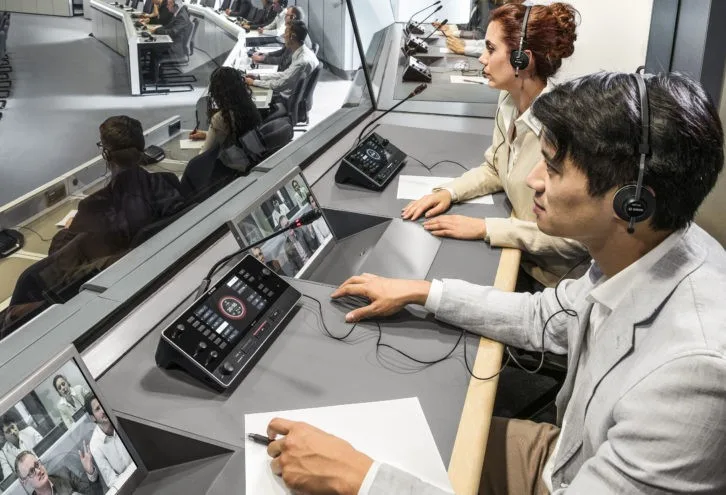
Simultaneous interpretation involves interpreting in real time while the speaker continues talking, often using headsets and soundproof booths. In Abu Dhabi, it is widely used for:
- International conferences and summits
- Government forums and policy roundtables
- Large corporate events and product launches
- High-level diplomatic meetings
For these events, Sim-trans Legal Translation & Interpretation Services can arrange not only experienced interpreters but also the necessary interpretation equipment, including booths, receivers, and technicians.
3.3 Whispered (Chuchotage) Interpretation
Whispered interpretation is used when only one or two individuals in a meeting need interpretation. The interpreter sits next to them and quietly interprets in real time. This is ideal for:
- Board meetings and committee discussions
- Site visits and inspections
- Confidential negotiations with a small number of stakeholders
3.4 Remote and Hybrid Interpretation
Abu Dhabi government agencies and businesses increasingly use remote interpretation via secure video or telephone platforms. This is particularly useful for:
- Cross-border regulatory meetings
- Virtual arbitration and mediation sessions
- Follow-up hearings or administrative updates
- Internal corporate trainings with regional teams
Remote interpretation can complement onsite services, especially when parties are in different Emirates or countries.
4. Matching Interpretation Services to Common Abu Dhabi Use Cases
Selecting the right interpretation mode is easier when you map it to the specific context you are dealing with. Below is a quick reference table for typical scenarios in Abu Dhabi.
| Use Case in Abu Dhabi | Recommended Interpretation Type | Key Considerations
|
|---|---|---|
| Court hearings, witness statements | Consecutive (on-site) | Interpreter should be court-experienced; Arabic usually required; confidentiality essential. |
| Notary public, contract signing, POA | Consecutive (on-site) | Legal terminology, familiarity with notary procedures, potential need for certified translation of documents. |
| Government conferences, public forums | Simultaneous (on-site with equipment) | Requires booths, receivers, event coordination, rehearsal with speakers. |
| Board meeting with one foreign investor | Whispered or consecutive (on-site) | Discretion, business and financial terminology, sensitivity to corporate hierarchy. |
| Virtual regulatory or compliance meeting | Remote simultaneous or consecutive | Secure platform, stable internet, clear audio; coordinate logins and test run in advance. |
| Medical assessment related to immigration or legal case | Consecutive (on-site or remote) | Patient confidentiality, medical terminology, cultural sensitivity. |
When you contact Sim-trans Legal Translation & Interpretation Services, sharing this context upfront allows the team to recommend the most efficient and compliant interpretation setup for your Abu Dhabi engagement.
5. How to Choose the Right Interpretation Partner in Abu Dhabi
Not all language providers are equipped to handle government-level expectations. Below is a structured approach you can follow when evaluating interpretation services in Abu Dhabi.
5.1 Step-by-Step Checklist for Vendor Selection
- Define the purpose and venue.
Is it a court matter, government meeting, or private corporate event? The more specific you are, the easier it is to match the right interpreter profile. - Confirm language pairs and direction.
Specify languages clearly, e.g., Arabic to English, Arabic to Russian, English to Chinese. Some government entities require Arabic to be involved as the official language of record. - Ask about government and legal experience.
Check whether the provider regularly works with Abu Dhabi courts, ministries, or regulators. Familiarity with local procedures is as important as language fluency. - Verify interpreter credentials.
For sensitive matters, request information about interpreter training, years of experience, and any relevant accreditations. - Assess confidentiality and data protection.
Ensure the provider has clear confidentiality policies and NDAs, especially for legal, medical, and financial content. - Review logistical capability.
For events, check if the provider can supply equipment, coordinate multiple interpreters, and manage schedules in line with government protocols. - Request a clear quotation and scope.
Rates may be hourly, half day, or full day. Clarify overtime, travel, cancellations, and whether preparation time is included.
Sim-trans Legal Translation & Interpretation Services follows this structured approach with clients in Abu Dhabi and across the UAE, helping you understand the implications of your choices before you commit.
5.2 Qualities to Look for in Interpreters
Beyond basic language fluency, effective interpreters for Abu Dhabi’s public and corporate sectors need:
- Legal and technical literacy: Ability to handle terminology in law, finance, energy, healthcare, and government policy.
- Cultural intelligence: Understanding of Emirati norms, religious sensitivities, and appropriate forms of address.
- Neutrality and professionalism: Interpreters must not influence the content, show bias, or offer advice during proceedings.
- Stress management: Ability to work under pressure in courtrooms, emergency situations, or high-stakes negotiations.
- Preparation habits: Serious interpreters request briefing materials in advance to ensure accurate and context-specific rendering.
A reputable provider will screen for these skills and match you with interpreters whose expertise aligns with your specific assignment.
6. Practical Tips for Succeeding with Interpretation Services in Abu Dhabi Government Settings
Having the right interpreter is only part of the equation. How you prepare and conduct the meeting or hearing also affects the success of the interpretation. Below are practical steps tailored to Abu Dhabi’s environment.
6.1 Before the Appointment or Event
- Book early: Court-qualified or highly specialized interpreters are in high demand. Reserve as soon as you know your date.
- Share background documents: Provide case summaries, contracts, agendas, or slide decks to your provider. This allows interpreters to prepare terminology and names.
- Confirm entry protocols: Ask the authority if interpreter details must be sent in advance, whether you need special passes, and what ID is required.
- Clarify roles: Ensure everyone understands that the interpreter is neutral and not an advisor, lawyer, or party to the case.
- Test technology for remote sessions: For online hearings or meetings, do a technical test at least 24 hours in advance.
6.2 During the Session
- Speak clearly and at a moderate pace: This is crucial, especially when the official record is being created.
- Pause appropriately for consecutive interpretation: Allow the interpreter to complete segments before continuing, particularly in courts or notary settings.
- Avoid side conversations: Ensure all speech goes through the interpreter, so nothing important is missed or misrepresented.
- Use simple, direct language: Especially when legal rights or obligations are being explained.
- Respect confidentiality in public spaces: When using interpreters in lobbies or waiting areas, be aware of who might overhear sensitive information.
6.3 After the Session
- Clarify next steps: If new dates or actions are mentioned in the hearing or meeting, confirm them before leaving.
- Debrief with your provider: Share feedback about the clarity, professionalism, and any challenges. This helps optimize future assignments.
- Secure related documentation: For example, if transcripts, translated documents, or minutes are needed after the event, arrange them through a trusted provider like Sim-trans Legal Translation & Interpretation Services.
7. Best Options for Interpretation Services in Abu Dhabi

When you evaluate the best options for interpretation in Abu Dhabi, consider both the service model and the provider’s local presence.
7.1 OnSite vs. Remote vs. Hybrid Options
- On-site interpretation:
Ideal for courts, notary visits, high-level meetings, and events where body language and physical documents play a major role. Abu Dhabi authorities often prefer on-site interpreters for formal proceedings. - Remote interpretation:
Best for follow up discussions, internal corporate meetings, or when participants are in different Emirates or countries. It offers flexibility and cost savings but depends heavily on stable connectivity. - Hybrid solutions:
Combine onsite and remote participants with interpretation bridging both. These are increasingly common for regional boards, multinational corporations, and international organizations based in Abu Dhabi.
7.2 Why Choose a UAE Based Provider with Local Offices
Working with a provider that has a physical presence in Abu Dhabi and Dubai offers distinct advantages:
- Faster coordination: Local teams can respond quickly to urgent court calls, last minute hearings, or government meetings.
- Better understanding of protocols: Local providers know which entities require advance approvals, security checks, or specific dress codes.
- Consistent quality across the UAE: If your operations span multiple Emirates, a UAE-wide provider can ensure the same standards in Abu Dhabi, Dubai, and beyond.
- Access to certified translation: In many cases, oral interpretation must be supported by certified written translations of documents.
Sim-trans Legal Translation & Interpretation Services fits this profile, combining local offices, UAE wide coverage, and a strong focus on legal and official communication for individuals, businesses, and government-related engagements.
8. How Sim-trans Supports Government and Corporate Clients in Abu Dhabi
As a specialized provider, Sim-trans Legal Translation & Interpretation Services offers a suite of solutions designed for Abu Dhabi’s legal and institutional landscape.
8.1 Core Services for Abu Dhabi Clients
- Legal and court interpretation: Interpreters experienced with hearings, witness testimonies, arbitration, and mediation.
- Government and notary interpretation: Assistance at notary offices, ministries, and other public authorities for contract signings, powers of attorney, and official declarations.
- Conference and event interpretation: Simultaneous interpretation for international conferences, exhibitions, and corporate events, including equipment rental and technical support.
- Business meetings and negotiations: Interpretation for investor meetings, board sessions, training workshops, and HR processes.
- Certified translation of supporting documents: Translation of contracts, certificates, judgments, and licenses that complement interpretation services for complete legal coverage.
8.2 Engagement Process
When you approach Sim-trans for interpretation in Abu Dhabi, the typical process looks like this:
- Initial consultation: You share the context, languages, date, venue, and any constraints.
- Service design: The team proposes the appropriate interpretation mode, number of interpreters, and any equipment required.
- Quotation and confirmation: You receive a clear scope and cost breakdown; once approved, interpreters are booked.
- Preparation and briefing: You provide documents and agendas; interpreters prepare terminology and coordinate logistics.
- Delivery and follow-up: The assignment is delivered on the agreed date, followed by feedback and ongoing support for future needs.
This structured approach helps ensure that your interpretation services in Abu Dhabi are not only linguistically accurate but also aligned with local expectations and legal requirements.
9. Frequently Asked Questions about Interpretation Services in Abu Dhabi

9.1 Do I need an interpreter for court if I speak some English or Arabic?
If the proceedings are in a language you do not fully master, you should request an interpreter. Legal terminology and procedural language are complex, and misinterpretation can affect your rights. Courts in Abu Dhabi often provide their own interpreters, but in some situations you may arrange your own through a professional provider, subject to court approval.
9.2 How far in advance should I book interpretation services in Abu Dhabi?
For legal and government matters, you should book as soon as your date is confirmed. For large conferences or events requiring equipment and multiple language booths, it is best to plan at least 4 to 8 weeks ahead, especially during peak seasons when many events take place in Abu Dhabi and Dubai.
9.3 Are interpreters in Abu Dhabi required to be certified?
For certain legal and court settings, interpreters may need to meet specific accreditation or registration criteria. For other corporate or event assignments, certification is not always mandatory, but experience and specialization are crucial. A provider like Sim-trans can help you determine what level of credential is needed for your particular case.
9.4 Can interpretation be done remotely for government hearings?
Some Abu Dhabi authorities allow remote interpretation via secure platforms, particularly for administrative hearings or follow-up sessions. However, policies differ between entities. You should confirm with the relevant authority and then coordinate with your interpretation provider to ensure technical and security requirements are met.
Provide a brief description of the case or meeting, languages involved, participant list, agenda, and any key documents (contracts, pleadings, presentations). The more context the interpreter has, the more accurate and nuanced the interpretation will be.
Source:
[1] Legal profession and legal consultation profession. (2022, January 2). Legal Guidlines. Retrieved December 30, 2025, from https://uaelegislation.gov.ae/en/legislations/1566
10. Conclusion: Using Interpretation Services in Abu Dhabi Strategically and Safely
In a city where legal, governmental, and business activities are deeply international, investing in professional interpretation services in Abu Dhabi is essential to protecting your rights, your reputation, and your commercial interests. Whether you are appearing in court, finalizing a contract at the notary, or hosting a high level conference, the right interpreters and the right preparation will determine how effective your communication truly is.
By understanding local government protocols, choosing an experienced UAE based partner like Sim-trans Legal Translation & Interpretation Services, and following best practices before, during, and after each assignment, you can navigate Abu Dhabi’s multilingual environment with confidence. To explore the broader strategy behind selecting, budgeting, and managing interpretation solutions across all your activities, make sure to review the main guide: Complete overview: “Interpretation Services: The Complete Guide to Choosing, Buying, and Succeeding.”
If you need tailored support for an upcoming legal matter, government appointment, or corporate event in Abu Dhabi or anywhere in the UAE, consider consulting Sim-trans for a customized interpretation plan that matches your exact requirements.