
In healthcare and life sciences, legal translation is not just a linguistic task; it is a regulatory, ethical, and patient safety requirement. From informed consent forms to Instructions for Use (IFUs) and regulatory submissions, a single mistranslation can derail approvals, delay product launches, or expose hospitals and manufacturers to serious legal risk.
This cluster guide explores how legal translation applies specifically to medical and life sciences documentation, and how providers in the UAE – especially in Dubai, Abu Dhabi, Sharjah, and Al Ain, can reduce risk by working with specialized legal and medical linguists. It complements our pillar resource, “Legal Translation Services: The Complete Guide.”
Drawing on the expertise of Sim-trans Legal Translation & Interpretation Services, a UAE based provider of certified translation and interpretation, this article breaks down what you need to know to protect patients, comply with regulators, and accelerate market access.
Why Legal Translation Is Critical in Healthcare and Life Sciences
Healthcare and life sciences sit at the intersection of medicine, technology, and law. Every document that involves patients, clinical data, or regulatory authorities must be accurate, consistent, and legally defensible in every language you use.
1) High Stakes Consequences of Errors
A misunderstanding in a marketing brochure may be embarrassing. A misunderstanding in a medical consent form or device IFU can be catastrophic. Consequences of poor legal translation in this sector include:
- Patient Harm: Patients or clinicians misinterpret usage instructions, contraindications, or dosage, leading to injury or death.
- Invalid Consent: If a patient cannot truly understand a translated consent form, the consent may be legally invalid.
- Regulatory Rejection: Authorities may reject or delay approvals if translations do not meet formal requirements.
- Litigation and Liability: Hospitals, CROs, and manufacturers can face lawsuits, fines, and reputational damage.
In the UAE, where healthcare providers routinely serve Arabic, English, Hindi, Urdu, Tagalog, and many other language communities, robust legal translation is essential to fair and safe patient care.
2) Where Legal and Medical Translation Overlap
Many healthcare and life science documents are both legal and technical. They use:
- Legal concepts: obligations, rights, liability, data protection, consent, indemnity.
- Medical terminology: diagnoses, procedures, pharmacology, device components, clinical endpoints.
This means they must be translated by professionals who understand both the legal framework (e.g., UAE health regulations, EMA/FDA styles, data protection rules) and the scientific language. That combination is a core part of what Sim-trans Legal Translation & Interpretation Services provides to hospitals, clinics, CROs, and manufacturers in Dubai, Abu Dhabi, Sharjah, and Al Ain.
Key Document Types: Consent, IFUs, and Regulatory Files

While healthcare organizations generate thousands of document types, three categories are especially sensitive from a legal translation perspective: informed consent documents, medical device and pharmaceutical IFUs, and regulatory submissions and compliance files.
1. Informed Consent Forms and Patient Information Sheets
Informed consent documents represent a contract like understanding between a patient (or research participant) and a provider or sponsor. They must clearly communicate:
- Nature and purpose of the treatment or study
- Risks, side effects, and potential benefits
- Alternatives and the right to refuse or withdraw
- How data and biosamples will be used and protected
- Any financial or insurance implications
For a non Arabic speaking expatriate in Dubai, or a non English-speaking national in Abu Dhabi, consenting to a medical procedure based on a document they cannot fully understand undermines the entire principle of autonomy and legal validity.
2. Instructions for Use (IFUs) and Labeling
IFUs, package inserts, labels, and manuals for:
- Medical devices and diagnostics
- Pharmaceutical products
- Healthcare software and connected devices
are core legal documents. They define intended use, limitations, warnings, and precautions. Regulators often treat them as part of the approval dossier and may require specific wording or mandatory phrases in local language.
A mistranslated contraindication or an ambiguous instruction to healthcare staff can become the focal point of a regulatory inspection or court case. High quality legal translation ensures content is clear, compliant, and defensible.
3. Regulatory Submissions and Compliance Documentation
Regulatory files in healthcare and life sciences typically include:
- Marketing authorization dossiers
- Clinical trial protocols and investigator brochures
- Ethics committee correspondence
- Post-market surveillance reports
- Adverse event reports and risk management files
In the UAE and abroad, authorities can require submissions or certain components (e.g., patient facing documents, safety summaries) in Arabic and/or English. Translators must follow strict templates and terminologies so the meaning stays consistent throughout the dossier.
Regulatory Expectations in the UAE and Internationally
Healthcare and life science organizations in Dubai, Abu Dhabi, Sharjah, and Al Ain often operate across jurisdictions GCC, EU, US, and Asia. Each region has its own expectations for legal translation.
1. Language and Certification Requirements
Common requirements you may encounter include:
- Official language mandates: For example, Arabic requirements for certain UAE regulatory submissions or patient-facing documents.
- Certified or sworn translation: Some regulators demand certified translations for contracts, clinical trial documentation, or authorizations.
- Terminology alignment: Use of specific glossaries or standardized medical and regulatory terms.
Sim-trans Legal Translation & Interpretation Services, based in Dubai and Abu Dhabi, is licensed to provide certified legal translation in the UAE, which is often necessary for regulatory or court-related documentation in the health sector.
2. Data Protection, Confidentiality, and Ethics
Working with patient data and clinical records adds another layer of responsibility:
- Patient identifiers and health information must be handled with strict confidentiality.
- Translators must follow non-disclosure agreements and robust data security processes.
- Translations must preserve legal disclaimers, consent clauses, and privacy terms precisely.
Ethically, mistranslation could invalidate privacy notices or consent for data usage, creating both compliance and reputational risks for hospitals and sponsors.
Translating Informed Consent: Legal and Ethical Essentials
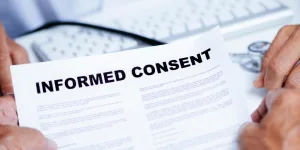
Informed consent is one of the most sensitive areas of legal translation in healthcare and life sciences, especially in diverse, multilingual settings like the UAE.
1. Plain Language vs. Legal Precision
Consent forms must balance readability for patients with legal robustness. Good translation practice includes:
- Using clear, patient-friendly language without diluting legal accuracy.
- Avoiding ambiguous phrasing that could be interpreted in multiple ways.
- Maintaining all rights, responsibilities, and risk statements from the source.
For example, the English phrase “You may withdraw at any time without affecting your future care” must be translated into Arabic (or another language) so that every nuance voluntary nature, no penalty, no impact on future treatment is preserved.
2. Cultural and Religious Considerations
Effective legal translation in consent documents also requires cultural competence:
- Respecting religious and cultural sensitivities around topics such as fertility, genetics, or end-of-life care.
- Using forms of address and tone appropriate to the patient population.
- Ensuring examples or explanations make sense in the local context (e.g., references relevant to patients in Dubai vs. Europe).
Experienced translators working with Sim-trans can advise on whether certain formulations might be misunderstood or considered insensitive in the UAE context, while still maintaining legal validity.
3. Process Best Practices for Consent Translation
- Draft in a clear source language (often English or Arabic) with legal and ethics teams.
- Engage specialized legal-medical translators who understand local laws and clinical processes.
- Use back-translation selectively for high-risk clinical trials or first-in-human studies.
- Pilot with real patients Confirm that they understand the translated form as intended.
- Update systematically When a protocol changes, ensure all language versions are updated consistently.
IFUs and Labeling: Translating for Safety and Compliance
IFUs and labeling are key risk documents in life sciences. They dictate how healthcare professionals (HCPs) and patients interact with drugs, devices, and diagnostics.
1) Key Elements that Demand Legal Grade Translation
- Indications and intended use Misstating what a product is for can expose you to off label use or misrepresentation claims.
- Warnings and contraindications These must be prominent and unambiguous in every language.
- Dosage and administration Numbers, units, and timing instructions must be 100% accurate.
- Storage and disposal instructions Errors can impact product stability or environmental compliance.
In Dubai or Abu Dhabi, where products may be used by Arabic- and English speaking staff in the same facility, consistency across both versions is crucial. Any discrepancy between languages can lead to confusion and liability.
2) Maintaining Consistency Across Markets
Medical device and pharma companies often use the same core IFU across the GCC, EU, and beyond, with local adaptations. To manage this:
- Develop a central terminology database for product labels and regulatory phrases.
- Use translation memory tools so recurring phrases (e.g., standard warnings) stay identical.
- Implement a version-control system so updates in one language cascade to others.
Sim-trans Legal Translation & Interpretation Services can build and maintain these resources for manufacturers, distributors, and hospital pharmacy departments across the UAE.
3) Example: Risky vs. Safe Translations
| Element | Risky Approach | Safe, Legal Translation Approach
|
|---|---|---|
| Warning statement | Literal translation that softens the urgency or changes the modality (“may” vs. “must”). | Functional equivalent that preserves legal force and matches regulatory phrasing in target language. |
| Dosage | Mixing commas/points (e.g., 1,5 vs 1.5) or translating units incorrectly. | Strict adherence to local standards for decimal notation and SI units. |
| Contraindications | Omitting complex medical terms the translator does not recognize. | Research and SME consultation to ensure all terms are translated or explained correctly. |
Regulatory Files and Clinical Documentation: Getting It Right First Time

Legal translation has a direct impact on how quickly products and studies progress through review. Incomplete or poor translations can lead to additional queries, site audits, or outright rejection.
1) Common Regulatory Documents Requiring Translation
- Clinical trial agreements and site contracts
- Ethics committee submissions and responses
- Regulatory correspondence with health authorities
- Risk-benefit analyses and safety reports
- Insurance policies related to clinical trials
Each of these has formal legal status and may be scrutinized in audits or litigation. Accurate legal translation ensures the content means the same thing in every language, so obligations, responsibilities, and timelines are clear.
2) Working with Cross Border Teams
Multinational projects often involve CROs in Europe or the US, sponsors in another region, and investigative sites in Dubai, Abu Dhabi, or Sharjah. To manage translation across this ecosystem:
- Define which language serves as the master version for each document type.
- Clarify approval workflows: who signs off the translated version (legal, medical, quality, local PI).
- Set translation SLAs that align with regulatory timelines and site start-up plans.
Sim-trans can integrate with your existing document control systems and quality processes, providing certified translations aligned with Good Clinical Practice (GCP) expectations.
How to Choose a Legal Translation Partner for Healthcare in the UAE
Selecting the right partner for legal translation in healthcare and life sciences can reduce risk and cost over the long term. A generic or “cheap” solution often becomes expensive when you factor in delays, rework, or regulatory issues.
1) Core Selection Criteria
- Dual expertise: Demonstrated experience in both legal and medical/life sciences translation, not just general content.
- Certification status: Authorization to provide certified legal translation that UAE courts and authorities recognize.
- Quality assurance: Clear QA workflow: translation, revision by a second linguist, final legal/technical review.
- Data security: Secure file transfer, confidentiality protocols, and NDAs for all staff.
- Local presence: Offices in Dubai or Abu Dhabi for easier coordination, hard copy stamping, and urgent turnaround.
Sim-trans Legal Translation & Interpretation Services fulfils these criteria, with specialized teams serving hospitals, pharmaceutical companies, CROs, and device manufacturers across Dubai, Abu Dhabi, Sharjah, and Al Ain.
2) Questions to Ask Prospective Providers
- Can you share examples of healthcare or clinical trial documents you have translated (with confidential details removed)?
- Are your translators native speakers of the target language and familiar with UAE legal and medical standards?
- How do you handle updates and version control when protocols or IFUs change?
- Do you provide certified legal translation where required by UAE authorities?
- What technology (CAT tools, terminology databases) do you use to ensure consistency?
Sim-trans Services for Healthcare and Life Sciences in Dubai and Across the UAE
As a UAE-based company with offices in Dubai and Abu Dhabi, Sim-trans Legal Translation & Interpretation Services offers a comprehensive portfolio tailored to the healthcare and life sciences sectors.
1) Document Translation Services
- Informed consent forms and patient information sheets
- IFUs, package inserts, and product labeling
- Clinical trial documentation and ethics submissions
- Regulatory filings and correspondence
- Hospital policies, SOPs, and compliance manuals
- Insurance policies and legal agreements
Translations are available between Arabic and English as well as other key languages used in the UAE, such as Hindi, Urdu, and more, depending on your patient and stakeholder needs.
2) Interpretation and Multilingual Support
Beyond documents, Sim-trans provides interpretation services that support clinical and business interactions, including:
- Onsite and remote interpretation for medical conferences and life sciences events in Dubai or Abu Dhabi
- Interpretation for regulatory meetings, ethics committee sessions, and investigator meetings
- Support for patient consultations and cross-border second opinions where appropriate
These services help ensure that all stakeholders clinicians, regulators, patients, and sponsors can communicate clearly, with legal and technical accuracy.
Practical Steps to Implement Robust Legal Translation in Your Organization
Whether you run a hospital in Sharjah, a clinic in Al Ain, or a regional life sciences hub in Dubai, you can strengthen your legal translation processes using the following framework.
1. Map your High Risk Documents
Identify all document types where mistranslation could create clinical or legal risk:
- Patient-facing documents: consents, leaflets, discharge instructions
- Regulatory and ethics materials: submissions, reports, approvals
- Product documentation: IFUs, labels, safety communications
2. Standardize Templates and Terminology
Work with your translation partner to develop:
- Bilingual or multilingual templates for recurring documents
- Approved glossaries for legal, medical, and institutional terminology
- Style guides specifying tone, reading level, and formatting preferences
3. Integrate Translation into your Quality System
Treat translation as part of your quality and risk management system, not an afterthought:
- Define responsibility for translation requests and approvals.
- Include translation checks in protocol amendments, IFU changes, and policy updates.
- Audit your provider periodically to confirm adherence to agreed standards.
4. Plan Timelines Realistically
High-quality legal translation requires sufficient time for translation, review, and corrections. When planning regulatory submissions or study startup in Dubai, Abu Dhabi, or Sharjah, build translation into your critical path rather than rushing at the last minute.
FAQ: Legal Translation in Healthcare and Life Sciences

1. Do all informed consent forms in the UAE need to be translated into Arabic?
Requirements depend on the regulator, ethics committee, and facility policies. Often, patient-facing documents should be available in the patient’s primary language, which for many will be Arabic. Others may require English or additional languages. A qualified legal translation provider can help you interpret local requirements and implement a practical multilingual strategy.
2. Is machine translation acceptable for internal clinical documents?
For low-risk internal communication, machine translation with human post-editing may occasionally be used. However, for patient-facing, regulatory, or legally binding documents, you should not rely on raw machine translation. These materials require professional legal translation with expert review to avoid safety and compliance issues.
3. How is confidentiality maintained when translating medical records or trial documents?
Reputable providers like Sim-trans use secure file transfer, limited-access systems, and NDAs with all staff and linguists. Patient identifiers can be minimized or pseudonymized where possible, and strict data protection procedures are followed throughout the translation lifecycle.
4. How long does it take to translate an IFU or consent package?
Timeframes depend on length, complexity, and language pairs. A short consent form may take 1–2 working days; a full IFU set or regulatory package can require several days to weeks, including review and QA. Discuss your timelines early with your translation partner so they can allocate appropriate resources.
Yes. Sim-trans Legal Translation & Interpretation Services is authorized to provide certified legal translation in the UAE, suitable for regulatory filings, court submissions, and other formal uses. This is particularly important when healthcare and life sciences documents form part of legal proceedings or official records.
Conclusion: Making Legal Translation a Strategic Asset in Healthcare and Life Sciences
In a complex, multilingual environment like the UAE, legal translation is a strategic safeguard for healthcare providers, life sciences companies, and patients alike. Accurate translations of consent forms, IFUs, and regulatory files uphold patient rights, support clinical safety, and streamline approvals.
By working with a specialized provider such as Sim-trans Legal Translation & Interpretation Services in Dubai and Abu Dhabi, organizations in Sharjah, Al Ain, and across the UAE can embed best-practice translation into their daily operations and long-term compliance strategy.
To understand how this healthcare-focused perspective fits within the broader world of multilingual compliance and risk management, explore our main guide, “Legal Translation Services: The Complete Guide“.
If you are planning a new clinical study, launching a medical device, or updating patient documentation in the UAE, consider partnering with Sim-trans from the outset to ensure your translations are accurate, compliant, and ready for regulatory scrutiny.