
When words carry legal consequences, translation is never just about language; it is about intent, enforceability, and risk. Legal translation converts texts used in courts, government agencies, and business transactions from one language to another without altering their legal effect. In the UAE, where Arabic is the official language and cross-border commerce is the norm, accurate and certified legal translation can determine whether a contract stands, a visa is approved, or litigation evidence is admissible.
This article explains what legal translation entails, its scope and standards, and how to know when you need it. For a broader context on providers, workflows, and service types, see our pillar guide: Complete overview: “Legal Translation Services: The Complete Guide.”
What Is Legal Translation?
Legal translation is the specialized conversion of legal documents such as contracts, court pleadings, powers of attorney, corporate records, and regulatory filings from a source language to a target language while preserving the document’s legal meaning and effect. It demands mastery of terminology, jurisdiction-specific concepts, and the consequences of even minor wording changes.
Unlike general translation, legal translation is bound by formal standards, certification requirements, and sometimes sworn translator rules. In the UAE, for example, many public authorities require Arabic translations carried out by licensed legal translators from the UAE Ministry of Justice for official use in courts or government procedures. This is why choosing a competent provider matters.
Legal translation is often paired with legal interpretation (for hearings, depositions, and conferences), but they are distinct services. Translation is written; interpretation is spoken. Each requires different skills, tools, and quality controls.
The Scope of Legal Translation: What It Covers

The scope spans personal, corporate, and public-sector needs. Below are common categories you may encounter in Dubai, Abu Dhabi, and across the UAE.
1) Personal and Civil Status Documents
- Birth, marriage, and divorce certificates
- Passports, ID cards, driver’s licenses
- Academic diplomas and transcripts
- Medical reports used for immigration or legal claims
- Wills, guardianship documents, and affidavits
These documents often require certified legal translation for visa applications, residency permits, and court filings.
2) Corporate and Commercial
- Articles of association, board resolutions, share certificates
- Commercial licenses and corporate registries
- Contracts and agreements (NDAs, distribution, employment, leases, franchise)
- Tenders and RFP responses
- Compliance policies and HR manuals
Companies operating in multilingual environments frequently need legal translation to ensure contractual alignment across jurisdictions and languages.
3) Litigation, Arbitration, and Dispute Resolution
- Pleadings, motions, and judgments
- Witness statements and expert reports
- Exhibits and evidence (emails, reports, technical specs)
- Arbitration rules, terms of reference, and awards
In arbitration and cross-border disputes, legal translation can affect admissibility and case strategy. Precise rendering of terminology and dates, and accurate transcreation of idioms and cultural references are critical.
4) Regulatory Filings and Government Communications
- Licensing submissions and approvals
- Data protection and compliance notices
- Customs, tax, and finance documentation
- Consumer protection and product labeling requirements
Regulatory language is formulaic and jurisdiction-specific. Translators must be familiar with the language of regulators and ministries in the UAE and internationally.
5) Intellectual Property
- Patent specifications and claims
- Trademark registrations and oppositions
- Licensing agreements and assignments
IP translation requires domain knowledge and precision: a single mistranslated claim element can undermine protection.
6) Immigration and Labor
- Work permits and employment contracts
- Visa and residency applications
- Company letters and HR attestations
For immigration procedures in the UAE, legal translation into or from Arabic is frequently mandated.
Standards, Certification, and Compliance
Legal translation follows strict quality and compliance frameworks that go beyond stylistic correctness.
Certification and Sworn Translation
- UAE requirements: For courts and most government authorities, Arabic translations typically must be completed or stamped by Ministry of Justice-licensed legal translators. Always check the receiving authority’s latest rules.
- Certified translations: A language service provider (LSP) issues a signed statement attesting to accuracy and completeness. Some processes also require notarization or legalization.
- Notarization/legalization: Depending on the file’s destination, documents may need notary stamps, MOFA legalization, or an apostille (for countries in the Hague Apostille Convention). Requirements vary by jurisdiction.
Quality and Process Standards
- ISO 17100 (translation services): Defines competencies, processes, and quality assurance for translation.
- ISO 20771 (legal translation): A specialized standard for individual legal translators, outlining competence, confidentiality, and professional conduct.
- Data handling and confidentiality: Secure file transfer, NDAs, and controlled access are standard practice for sensitive legal documents.
Providers such as Sim-trans Legal Translation & Interpretation Services embed these controls—bilingual revision, subject-matter review, and final QA—to ensure documents meet the legal intent of the original.
Useful Resources:
Popiołek, M. (2020). ISO 20771:2020 overview and legal translator competence requirements in the context of the European Qualifications Framework, ISO 17100:2015 and relevant research. Lingua Legis, 2020(28), 7–40. https://doi.org/10.32612/uw.25434357.2020.28.pp.7-40
Popiołek, M. (2020b). ISO 20771:2020 overview and legal translator competence requirements in the context of the European Qualifications Framework, ISO 17100:2015 and relevant research. Lingua Legis, 2020(28), 7–40. https://doi.org/10.32612/uw.25434357.2020.28.pp.7-40
The Legal Translation Workflow: Step by Step
While each case is unique, an efficient workflow safeguards accuracy and deadlines:
- Intake and scoping: Define purpose, receiving authority, languages, certification needs, and deadlines. Identify any official templates or required phrasing.
- Terminology capture: Build or apply a glossary and translation memory (TM) to ensure term consistency across documents and versions.
- Confidentiality measures: Please execute NDAs as needed and restrict access to the project team.
- Translation: Assign to experienced legal translators with proven expertise in the relevant legal system(s).
- Bilingual editing: A second linguist reviews accuracy, terminology, and style in line with ISO 17100.
- Legal or subject matter review: Optional, but advisable for complex contracts, IP, or regulatory filings.
- Formatting and compliance: Match original layout, references, numbering, exhibits, and annexes. Insert translator notes where required.
- Certification and stamping: Provide certified translation, sworn translator stamp, and any required notarization or legalization for UAE use.
- Final QA and delivery: Secure handover in editable and PDF formats, with a record of version control.
When You Need Legal Translation
There are clear triggers for engaging a legal translation provider in the UAE and beyond:
- Submitting documents to UAE courts, ministries, or free zone authorities that require Arabic translations performed by licensed legal translators.
- Executing cross-border contracts where parties speak different languages or where the governing law requires a specific language version.
- Multilingual evidence, witness statements, or awards in arbitration must be enforceable in multiple jurisdictions.
- Immigration applications (residency, work permits, and family sponsorship) require certified translations of civil status records.
- Corporate compliance, tenders, and RFPs require precise alignment between English and Arabic versions.
- Intellectual property filings, such as patent claims, require precise alignment across languages without compromising their scope.
- Real estate transactions and notarizations involving multilingual parties or authorities.
In each scenario, the stakes are legal, not merely linguistic. Choosing professional legal translation helps avoid rejected filings, enforcement issues, and costly delays.
Common Pitfalls and How to Avoid Them
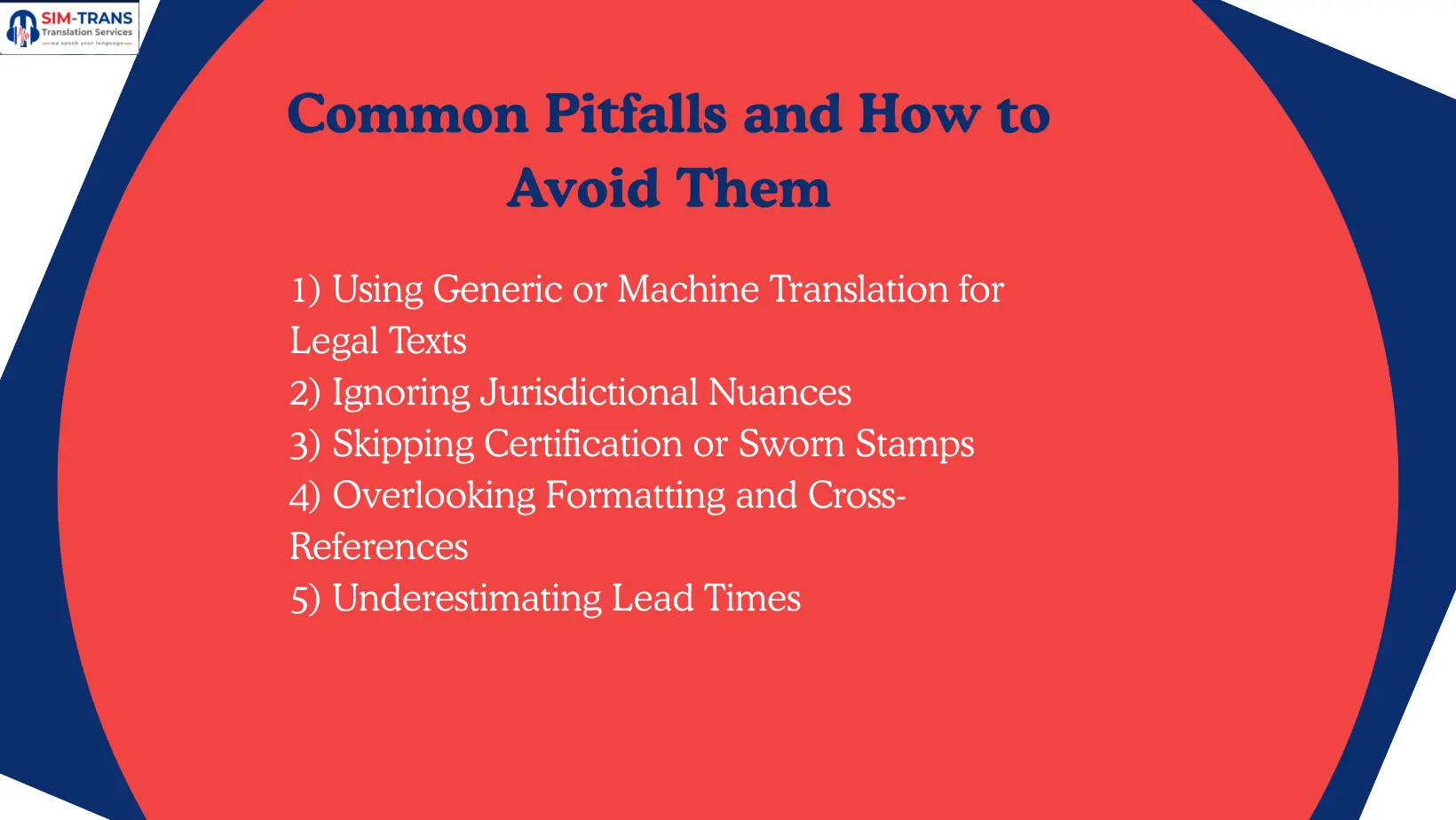
1) Using Generic or Machine Translation for Legal Texts
Even advanced machine translation tools may introduce ambiguity, mistranslate defined terms, or mishandle dates and numerals risks that can void a contract clause or undermine evidence. For official submissions, machine output is almost never accepted.
2) Ignoring Jurisdictional Nuances
Legal concepts rarely map directly across languages. For example, civil law and common law systems use different terminology, remedies, and procedural concepts. Legal translators must interpret the concept first, then find the term that preserves legal effect.
3) Skipping Certification or Sworn Stamps
Many UAE authorities will reject translations lacking the proper stamp or certification. Always confirm the receiving authority’s requirement in advance.
4) Overlooking Formatting and Cross-References
Missing defined-term capitalization, clause renumbering, or exhibit mismatches can create inconsistencies that affect enforceability. Robust QA avoids these errors.
5) Underestimating Lead Times
Complex matters like arbitration bundles, regulatory dossiers, or high-volume discovery require careful scheduling and multiple linguists. Plan early and ask your provider for capacity planning and version control protocols.
How to Choose a Legal Translation Provider
Use this checklist to assess providers in Dubai, Abu Dhabi, and across the UAE:
- Authority readiness: Can they provide Ministry of Justice-licensed legal translations when required?
- Qualifications: Do translators demonstrate legal expertise, proven experience, and adherence to ISO 17100/20771?
- Quality process: Is there independent bilingual review, legal SME input, and final QA?
- Security: Are files handled via secure portals, with NDAs and access controls?
- Capacity: Can they scale for large cases and manage tight deadlines?
- Formatting: Do they deliver publisher-ready documents mirroring the source layout?
- Transparency: Clear pricing, scope, and turnaround, with written service-level expectations.
Sim-trans Legal Translation & Interpretation Services offers certified and legal translation throughout the UAE, with teams experienced in court filings, corporate transactions, and multilingual events and conferences. If you need multi-document, multi-jurisdiction support, ask Sim-trans about structured workflows and dedicated project management.
Comparison: General vs. Legal vs. Machine Translation
| Criterion | General Translation | Legal Translation | Machine Translation
|
|---|---|---|---|
| Accuracy for Legal Effect | Moderate | High (with review and QA) | Unreliable for legal use |
| Certification/Sworn Stamps | Typically no | Yes (as required by authority) | No |
| Terminology Control | Limited | Glossaries, TMs, SME review | Variable; lacks legal nuance |
| Court/Authority Acceptance | Rarely | Yes (when certified/licensed) | No |
| Risk of Misinterpretation | Medium | Low (with proper process) | High |
Cost, Timelines, and What Affects Both
Costs and turnaround for legal translation vary widely. Key factors include:
- Language pair and direction (e.g., English to Arabic vs. less common languages)
- Complexity and specialization (contracts vs. patents vs. litigation bundles)
- Certification needs (licensed legal translator stamp, notarization, legalization)
- Volume, repetition, and formatting complexity (tables, exhibits, seals)
- Urgency and weekend/after-hours delivery
In the UAE, some authorities and processes require specific stamp formats, which can influence cost and delivery time. Providers may quote per word for standard documents or per page for certain certified items. For complex, multi-document cases, expect project-based quotes with clear scopes and milestones.
Tip: Ask your provider to leverage translation memories (TMs) for recurring clauses to reduce cost and ensure consistency over time.
Best Practices for Commissioning Legal Translation
- Provide editable files when possible (Word, Excel) to preserve formatting and speed up delivery.
- Share the purpose and the receiving authority’s guidance; include any required templates or reference documents.
- Flag defined terms, abbreviations, and jurisdiction-specific concepts.
- Align on certification needs early (licensed stamp, notarization, legalization).
- Plan for review: allocate time for questions, clarifications, and final checks.
- For high-stakes documents, request SME review by a legal professional with relevant jurisdictional experience.
Sim-trans Legal Translation & Interpretation Services can advise on documentation requirements across UAE authorities and coordinate stamps, notarization, and legalization where needed, saving you time and mitigating risk.
FAQs: Legal Translation in the UAE
Q: Is legal translation the same as certified translation?
Not always. Legal translation refers to the subject matter (legal documents). A certified translation is a signed statement of accuracy from the provider. In the UAE, many authorities require Arabic translations completed by Ministry of Justice licensed legal translators; some processes also require notarization or legalization.
Q: Are Arabic translations mandatory for all UAE filings?
Requirements vary by authority and process. Courts and many government bodies require Arabic as the official language for filings. Always confirm with the receiving authority or consult a provider familiar with UAE rules.
Q: Can I use machine translation and have it post-edited?
For legal documents intended for official use, machine translation is not recommended and often not accepted. Human translation by qualified legal linguists with proper review and certification is the safer path.
Q: How long does legal translation take?
Timelines depend on length, complexity, language pair, certification steps, and urgency. A short certificate can be completed quickly, while multicontract deals or arbitration bundles require more time and resourcing. Could you please provide a project plan that includes time for review and stamping?
Q: Will my documents remain confidential?
Reputable providers enforce strict confidentiality: NDAs, secure transfer, controlled access, and data retention policies. Sim-trans uses secure workflows and can sign NDAs on request.
Conclusion: Getting Legal Translation Right
Legal translation safeguards enforceability, compliance, and outcomes across borders. Whether you’re filing with a UAE authority, closing a cross-border contract, or preparing for arbitration, professional legal translation provides the accuracy, certification, and confidentiality your matter demands. To dive deeper into service models and end-to-end workflows, see our pillar guide: Complete overview: “Legal Translation Services: The Complete Guide.”
For responsive support in Dubai, Abu Dhabi, and across the UAE, contact Sim-trans Legal Translation & Interpretation Services. Our licensed translators, legal reviewers, and project managers deliver certified translations tailored to court, government, or corporate requirements on time and with meticulous care.