
When you plan a high-stakes event in the UAE, whether it’s a board meeting in Dubai, a government summit in Abu Dhabi, or a multi-market product launch, you need more than bilingual talent. You need a professional, well-orchestrated system that brings language access to every participant. This is where interpretation services shine. In this deep dive, you’ll learn how conference interpreting actually works: the booths that house interpreters, the equipment that delivers pristine audio, and the team roles that keep the whole operation running smoothly. For a broad foundation on selecting and buying interpretation services across all use cases, see Complete overview: “Interpretation Services: The Complete Guide to Choosing, Buying, and Succeeding.”
Conference Interpreting 101: Where It Fits in Interpretation Services
Conference interpreting is a specialized branch of interpretation services designed for large or complex events where real-time multilingual communication is essential. Unlike ad hoc or informal interpreting, it uses standardized equipment, ISO-compliant booths, and professional teams scheduled in shifts to protect interpreter performance and attendee experience.
Modes you’ll encounter
- Simultaneous interpreting: Interpreters listen and speak at the same time from soundproof booths. Ideal for conferences, plenaries, and parallel sessions.
- Consecutive interpreting: The speaker pauses, and the interpreter renders in segments. Best for keynotes, Q&A, and high-ceremony settings.
- Whispered interpreting (chuchotage): The interpreter whispers to one or two delegates; this type of interpretation is suitable for tours or small meetings.
- Remote Simultaneous Interpreting (RSI): Interpreters work through a cloud platform; audiences access translations via headsets or personal devices.
In the UAE, events often blend modes: simultaneous for plenaries, consecutive for VIP remarks, and whispered interpreting for side meetings. A seasoned partner like Sim-trans Legal Translation & Interpretation Services will help you match the mode to the format, venue, and audience profile.
Inside the Booth: Design, Standards, and Placement

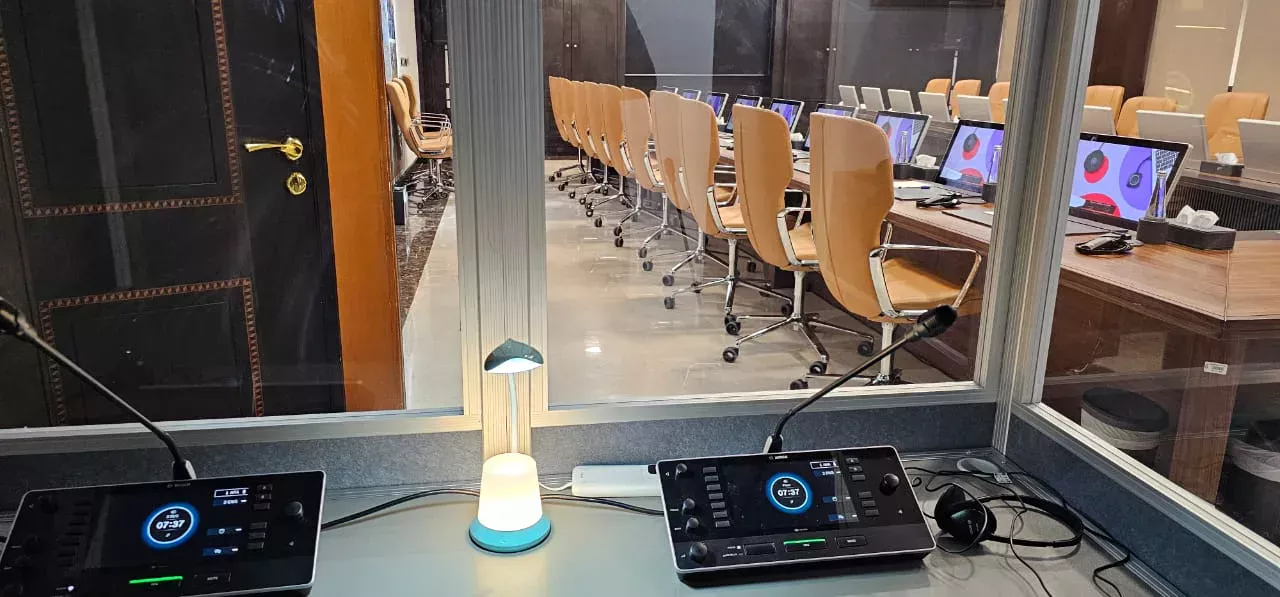
The interpreter’s booth is mission-critical. It creates an acoustically controlled environment so interpreters can deliver accurate speech at a sustainable cognitive load. Booth quality directly affects audience comprehension and interpreter stamina.
1) Types of booths
- ISO-compliant mobile booths: Modular, sound-isolating cabins with ventilation and lighting. Suitable for conferences and multi-day events.
- Tabletop booths (portable hoods): Lightweight partial enclosures for small rooms or tight budgets; offer limited sound isolation.
- Built-in booths: Integrated into some venues (e.g., Dubai World Trade Centre or ADNEC breakout halls); often provide excellent sight lines.
Useful Source:
ISO 4043. (2016, March 3). International Organization for Standardization. Retrieved December 4, 2025, from https://www.iso.org/standard/67066.html
2) Placement and sight lines
Ideal booth placement is in the same room as the speakers and audience, with a direct line of sight to the podium, panel, and screens. Interpreters rely on visual cues like slides, gestures, and facial expressions to interpret idioms, humor, and technical references accurately. When direct sight is impossible, high-quality video feeds are mandatory.
3) Ergonomics and comfort
- Quiet, stable ventilation to prevent “booth fatigue.”
- Adjustable lighting for reading scripts and seeing the console.
- Two ergonomic seats per booth (standard for simultaneous teams).
- Cable management helps avoid trip hazards.
Tip: Book booth space early. Venues in Dubai and Abu Dhabi fill quickly during peak seasons (major exhibitions, government forums, and cultural festivals), and room layouts affect booth acoustics and audience distribution.
The Equipment Stack: From Microphone to Audience Ear
Interpretation services rely on a synchronized signal chain from speaker to interpreter to audience. A breakdown at any point compromises clarity and trust.
1) Core components
- Interpreter consoles: Allow channel selection, relay setup, microphone on/off, cough mute, and volume control. Professional consoles also enable handover signals between team members.
- Microphones: Gooseneck mics in booths; boundary or handheld mics for speakers. Consistent mic discipline reduces clipping and background noise.
- Headsets: Closed-back headsets ensure intelligibility and protect hearing during long sessions.
- Transmitters and distribution: Infrared (IR) or Radio Frequency (RF) systems broadcast language channels to audience receivers; wired/wireless hybrids are common.
- Receivers and headphones: Delegates select their preferred language channel and adjust volume.
- Audio processing: Mixers, DSPs, and recorders with backup power to ensure consistent levels and redundancy.
2) IR vs RF distribution
| Criteria | Infrared (IR) | Radio Frequency (RF)
|
|---|---|---|
| Interference | Low; light-based, not affected by Wi‑Fi | Possible in RF‑dense venues; must be coordinated |
| Security | Confined to room; signal doesn’t pass walls | May spill beyond room; encryption recommended |
| Setup | Requires line-of-sight radiators | Flexible placement, less line-of-sight dependent |
| Use cases | Boardrooms, plenaries, sensitive sessions | Large, complex multi-room events |
Source:
Abstract ISO 20108. (n.d.). International Organization for Standardization. Retrieved December 4, 2025, from https://www.iso.org/standard/67062.html
3) Remote Simultaneous Interpreting (RSI) platforms
RSI platforms route audio/video to interpreters working from certified hubs or approved home studios and then stream language channels to on-site receivers or attendees’ devices. When using RSI in the UAE, ensure:
- Redundant connectivity (wired and 5G), local server options, and clear data-protection policies.
- Acoustic treatment and hardware that meet platform certification standards.
- On-site backup: a small IR/RF system or hybrid workflow if internet issues arise.
Who Does What: Team Roles That Power Conference Interpreting

Successful interpretation services hinge on coordinated human expertise. Here’s the typical lineup you’ll see at conferences in Dubai, Abu Dhabi, and across the UAE.
Interpreter roles
- Conference interpreters (simultaneous): Work in pairs per language channel, rotating every 20 to 30 minutes to manage cognitive load. Many follow AIIC professional standards.
- Consecutive interpreters: Handle short segments, Q&A, and keynote remarks where pauses are acceptable.
- Relay/pivot interpreters: When language A doesn’t have direct coverage to language B, interpreters work through a pivot language (e.g., Arabic to English to Japanese).
- Language profiles: Interpreters list A (native/active), B (near-native active), and C (passive) languages to guide assignments.
Operational roles
- Chief interpreter/team leader: Oversees linguistic strategy, glossaries, and team coordination.
- Project manager (LSP): Your single point of contact at Sim-trans for scoping, scheduling, documentation, and stakeholder communication.
- Audio/AV engineer: Designs the signal path, ensures clean feeds, and manages backups.
- Booth technician: Installs, tests, and monitors consoles, headsets, and distribution systems.
- Floor manager: Coordinates headset distribution, signage, and seating for multilingual audiences.
For mid-sized conferences, expect two interpreters per language channel, plus one AV engineer and a booth technician. Large congresses may require multiple parallel rooms, a chief interpreter, and additional logistics staff.
From Brief to Applause: The End-to-End Workflow
- Discovery: Define goals, languages, audience size, agenda, and confidentiality. Identify whether simultaneous, consecutive, or hybrid interpretation services fit best.
- Venue survey: Assess booth placement, stage layout, power, cable runs, and internet redundancy. Secure approvals with venue management (e.g., DWTC, ADNEC).
- Team assembly: Assign linguists by subject matter (legal, medical, finance, technology). In the UAE, Arabic–English is common, with frequent needs for French, Russian, Chinese, Hindi/Urdu, and Farsi.
- Equipment design: Choose IR or RF distribution, number of channels, and backup systems; plan for recording if required.
- Preparation materials: Collect scripts, slides, speaker bios, videos, and terminology. Build a shared glossary to standardize usage.
- Rehearsal and testing: Full signal checks (stage to booth to receivers), interpreter sightline verification, and channel mapping validation.
- Showtime operations: Timekeeping for handovers, continuous monitoring of audio levels, and liaison with stage managers for last-minute speaker changes.
- Debrief and deliverables: Optional recordings, feedback, and glossary updates for future events.
Sim-trans Legal Translation & Interpretation Services guides you through each stage, aligning linguistic teams with the AV design so your multilingual program feels seamless and effortless to attendees.
Budget, Quality, and ROI: What Drives Cost in Interpretation Services
Transparent pricing protects your program and reputation. Cost drivers typically include:
- Languages and channels: Each language requires its own booth team and channel.
- Event duration: Half-day vs. multiday; evening or weekend premiums may apply.
- Subject-matter complexity: Technical topics demand specialized interpreters and more prep time.
- Equipment scope: Number of booths, receivers, distribution technology (IR vs. RF), and redundancy.
- Logistics: Venue layout, travel within the UAE, setup/strike windows, and storage.
- Remote/hybrid: RSI platform licensing, certified hubs, and connectivity redundancy.
Value tip: Share your agenda early and confirm languages well in advance. This enables Sim-trans to secure top interpreters and optimize the equipment plan often the difference between good and exemplary outcomes.
Onsite vs Remote vs Hybrid: Choosing the Right Delivery Model
| Model | Strengths | Considerations | Best for
|
|---|---|---|---|
| On-site | Highest audio quality, natural interaction, secure IR distribution | Requires booth space, more logistics | Plenaries, high-profile summits, confidential meetings |
| Remote (RSI) | Flexible talent sourcing, scalable, reduced travel | Network dependency, platform costs, attendee device management | Short sessions, webinars, multi-time-zone panels |
| Hybrid | Mix of on-site presence and remote redundancy | More planning complexity; clear run-of-show essential | Multi-venue events, large expos, contingency-sensitive programs |
In Dubai and Abu Dhabi, many organizers adopt hybrid models: on-site booths for main rooms, RSI for overflow rooms, and bilingual staff for exhibitor interactions. Sim-trans can advise on the optimal blend to balance quality, risk, and budget.
Quality Assurance, Risk Management, and Ethics
1. Audio standards and speaker coaching
- Target speaking rate: around 120 to 140 words per minute for intelligibility.
- Encourage mic discipline: one person speaking at a time, minimal paper rustling, and avoid walking away from microphones.
- Provide prerecorded videos and last-minute slides to the team in advance when possible.
2. Redundancy in critical paths
- Backup power (UPS) for consoles and transmitters.
- Secondary microphones and spare headsets.
- For RSI, ensure there are dual internet connections and hot failover plans in place.
3. Confidentiality and compliance
- NDAs for interpreters and vendors; role-based access to materials.
- Data protection and secure content handling are crucial, especially for legal or financial sessions.
- Adherence to professional codes (e.g., AIIC standards) and applicable ISO guidelines.
Source:
Code of Professional Ethics. (n.d.). AIIC Code of Professional Ethics. Retrieved December 4, 2025, from https://aiic.org/document/10277/CODE_2022_E&F_final.pdf
Practical Checklists You Can Use
Pre-event checklist
- Languages, channels, and mode confirmed
- Venue survey completed; booth locations agreed
- Equipment plan approved (IR/RF, receivers count, recording)
- Interpreter roster assigned (subject matter, A/B/C profiles)
- Preparation materials delivered (slides, scripts, glossaries)
- Rehearsal and full signal test scheduled
- Attendee comms prepared (how to use receivers, channel list)
Show day checklist
- Booths powered and ventilated; consoles calibrated
- Channel mapping confirmed; labels visible at help desks
- Headset distribution staffed; spare batteries on hand
- AV engineer monitoring levels; technician at booths
- Interpreter handover timing agreed (20 to 30 min rotations)
- RSI backups online (if hybrid), network health monitored
Local UAE Considerations and Examples
- Language mix: Arabic to English is foundational, often with French, Russian, Mandarin, Hindi/Urdu, and Farsi. Industry-specific sessions (e.g., energy or healthcare) may require niche languages.
- Venue nuances: Expo halls require careful IR radiator placement and noise mitigation; boardrooms favor compact IR and tabletop booths.
- Cultural protocols: For government delegations, plan for consecutive interpreting during formal greetings and simultaneous interpreting for the working agenda.
- Documentation: For legal and policy events, integrate certified translators for post-event document translation to maintain continuity and record integrity.
Sim-trans Legal Translation & Interpretation Services operates across Dubai, Abu Dhabi, and the wider UAE, bringing together ISO-aligned equipment, vetted conference interpreters, and project managers who understand local venue operations and protocols.
Frequently Asked Questions (FAQs)

Q: How many interpreters do I need per language?
For simultaneous conference interpreting, plan for two interpreters per language channel to rotate every 20–30 minutes. Highly technical or all-day programs may add a third interpreter for resilience.
Q: Do I always need full booths?
For large rooms, yes, ISO-compliant booths provide the isolation and ergonomics required for quality output. In small meetings with limited channels, tabletop booths can work, but expect lower sound isolation.
Q: What if my speakers change at the last minute?
Please share the updated slides/scripts at your earliest convenience. A seasoned provider builds in buffer time and maintains a live glossary, which allows interpreters to adapt quickly.
Q: Is remote interpreting as effective as on-site?
With certified equipment and robust connectivity, RSI can be excellent. However, on-site interpreting still offers the most reliable audio and natural interaction. Hybrid setups can deliver strong results when the appropriate risk controls are implemented.
Q: How far in advance should I book?
For major conferences in the UAE, it is advisable to secure your interpretation services 6 to 8 weeks in advance, and even longer if you require multiple languages or specialized subject matter expertise.
Conclusion: Make Interpretation Services Your Competitive Advantage
World-class conference interpreting is equal parts engineering, linguistics, and stagecraft. When booths are properly placed, equipment is professionally engineered, and teams are expertly led, your multilingual program feels effortless, and your content lands with every audience. If you’re planning an event in Dubai, Abu Dhabi, or anywhere in the UAE, partner with Sim-trans Legal Translation & Interpretation Services to scope, staff, and deliver interpretation services that meet international standards. For broader guidance on selecting and managing providers, see Complete overview: “Interpretation Services: The Complete Guide to Choosing, Buying, and Succeeding.”